
Expanding Intervals to the Next Octave
This is a short list of the interval meanings, and we go into detail in the workbook lessons. This Table is used to reference the intervals you can extend into the upper octave.
The following briefly explain the distances and ranges over two octaves (notes): M=major, m or (-) = minor, #=sharp, b=flat, octave=8va. (vb, for lower)
Review the table below for the first major and minor intervals. Use the keyboard to see the intervals for the upper octave.
| Interval | Example | Label (1/2 steps) |
| Minor Second | C to C# | m2 (1) |
| Second | C to D | 2 (2) |
| Minor Third | C to Eb | m3 or b3 (3) |
| Major Third | C to E | 3 (4) |
| Perfect Fourth | C to F | 4 (5) |
| Tritone (#4, b5) | C to F# or Gb | #4, b5 (6) |
| Perfect Fifth | C to G | 5 (7) |
| Minor Sixth | C to Ab | m6 or b6 (8) |
| Major Sixth | C to A | 6 (9) |
| Dominant Seventh | C to Bb | b7 or m7 (10) |
| Major Seventh | C to B | M7 (11) |
| Octave | C to C (8va) | 8 (12) |
| The extended intervals are often called the jazz notes. The sounds become attonal in nature.
Notice that if you take any of the above intervals and add 7 to them you create the extended series. That means that if you play a 7th be it dominant or major any of the even numbered intervals will become odd and can be considered an extend or advanced interval. Example: Playing a C, D, G and Bb. The D can be considered a 9th interval even though it is played next to the C. This relates to the ability to invert notes which you will learn about in chord theory. 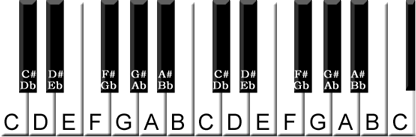 Here are the Advanced Intervals: |
||
| Interval Name | Each interval is an octave higher 8va | The Extended Interval |
| Minor Ninth | C to Db | m9 or b9 (13) |
| Nineth | C to D | 9 (14) |
| Sharp Nine | C to D# | #9 (15) |
| Minor Tenth (m3) | C to E | m10 (m3 one octave up) (16) |
| Eleventh | C to F | 11 (17 |
| Sharp Eleventh | C to F# | #11 (18) |
| Twelevth (5) | C to G | 12 (5 one octave up) (19) |
| Flat Thirteenth | C to Ab | b13 or m13 (20) |
| Thirteenth | C to A | 13 (21) |
| Sharp Thirteenth | C to A# | #13 (22) |
| Flat Fiftheeth | C to Bb | b15 (23) |
| Fifthteenth | C to B | 15 (24) |
The extended intervals are often called the jazz notes. The sounds become atonal in nature.
Notice that if you take any of the above intervals and add 7 to them you create the extended series.
That means that if you play a 7th be it dominant or major any of the even numbered intervals will become odd and can be considered an extend or advanced interval.
Example: Playing a C, D, G and Bb. The D can be considered a 9th interval even though it is played next to the C. This relates to the ability to invert notes which you will learn about in chord theory.
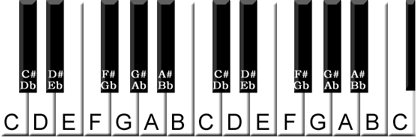
For now we’ve only touched on relative position. There are other rules we will explore in detail on later lessons associated with music theory and use of the intervals.
 Learning Resources