
How to Move Around the Basic Chords of Music
 Chord Progressions are one of the most asked about music topics around.
A sequence of chords is what makes music flow from one place to another.
A composer of music may use one chord over many measures to add melody and flavor to their music. Eventually they will move to another chord to keep the song or music piece interesting.
In other cases the music may change chords on every beat. What seems to elude most beginning students is what how these musicians decide on what chord to use next.
Where to Start:
Quick frankly, you do need a good handle on harmonic systems ( the chords used in the musical scale or key signature that you will play or write your song). We’ll talk about basic progressions here to set a foundation. In the next lesson playing them in close chord or easy movement will be discussed.
Lets take the C major scale as an example. The Major C Chord harmonic system will be composed of the three major chords, three minor chords and one diminished chord. ( C major, F major, G major, D minor, E minor, A minor and B diminished)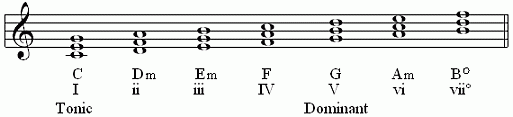
It is absolutely possible to go from any chord to another chord. If it sounds good to you then it is good. Even when it doesn’t it creates a new scenario or sets up an opportunity to go elsewhere to a chord that resolves the odd sound.
Best advice I ever got was audition the sound. Try it several ways and see what happens. Don’t like the musical sound, don’t use it. OK, but what about common progressions?
There are tons of them, but you need to start slowly and get a few ideas under your hat before you take off and harmonize the next great song.
Basic Two Chords Used in a Progression
The V and I chords can dominate a piece of music as they are the two chords that stand out in the major harmonic system, and even in the minor harmonic systems.
Chopin composed a several pieces of music where 70% to 90% of the song used only these two chords. He added all sorts of expert level techniques for scales melody, trills, and inversions to make these popular songs of his time.
So it doesn’t take lots of changes to have a chord progression.
Most Common Major Chord Progressions
The use of the three major chords can form some of the most common chord progressions used in rock and pop songs today.
Let’s look at an example, using the I IV and V Chord Positions.
Start with a simple change in the major chords:
I IV V7 I
C F G7 C
This progression of major chords is a happy up beat cadence found in many songs.
The V7 to I movement is called “GOING HOME”, the dominant chord to tonic. This chord action is so common you had better get to know it cold. You will recognize it just by the feel when listening to music, it’s that feeling of satisfaction and resolution when this shift takes place.
The V7 sets up a tension that just naturally resolves to the Tonic “I” chord. More on a three seventh chord combination that is used in jazz shortly.
The Blues Chords Using Major Chords
The Blue 12 Bar Progression uses these three major chords. However, they alternate heavily from I to IV then use a V7 to IV to I sequence to come home and repeat the 12 bars. Here is the typical 12 bar blues progression (there are variations)
I IV I I
IV IV I I
V7 IV I I(V7)
substitute a V7 in place of I at the end to keeping repeating, and then end with the I to finish.
Using All the Chords in Your System for Progressions
As stated before you have to try the chords out to see how they work for you. I’m going to give you a chord progression that is based on the circle of fifths idea.
It works very well to demonstrate a dominate progression. And is based as discussed above for the dominant chord to tonic movement of a fifth.
In the Creating Chords Workbook we discuss this in more detail and take time to show you how it works and then how to optimize it for playing.
For this lesson we will discuss the concept of moving in fifths. Starting out on the tonic you can choose to go to any chord you wish.
We are going to start by simply moving in fifths down the chords.
The first move will be from C chord down a fifth to F on our circle. Then we will continue in that method to complete the series of chord movements.
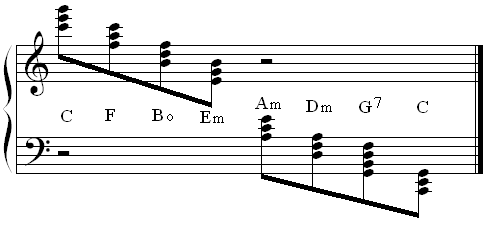
OK, look at the fifth changes C to F to B dim (dim fifth movement) to Em to Am to Dm to G7 and finally back to C.
Now we take that progression of chords and rearrange them into one
octave.
(R means root chord position, this is done purposely so you can see the progression it is not the best way to play them, that’s in the next lesson)
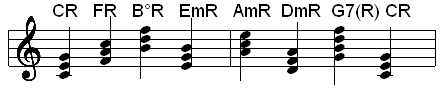
Our staff shows them in one octave range.
This can foul you up. So be clear the chord changes were fifth changes down if you counted down a keyboard starting on an upper C. However, we decide to play it at a different location. What you actually saw was a fourth movement up on the staff.
To review this go back to the key signatures pages and review the fifth and fourth relationships. If you have a piano you can play the chords as shown above or start up high and play down the keyboard by fifths for each chord.
Notice one thing here your hand always has the same shape when it plays each of the root chords. That simple means you get to move your hand as a whole and don’t have to worry about moving your fingers around.
Except of course for the V7 chord.
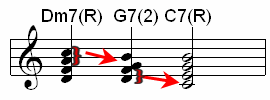
The ii7 – V7 – IM7 Motion
At the end of the last progression we show the ii – V – I series. This is incredibly common in the jazz world, to the point of being able to play it so often it will bring you to tears using this order of chords so much.
Here it is shown in the basic position. There are inversions of this that can also be learned.
This is a tight movement of notes to accomplish this well known use of chords. In the next lesson we will talk about the close chord changes and common notes.
Advice on Learning About Music Flow
We touched on some typical examples of chord progressions and how to start looking at them. Here is the best suggestion I can give you other than working through tons of books.
Analyze other composers music. See what they have done and reduce it back to the roman numeral system. Take 10 pieces of music determine the chords, write them out, figure out the harmonic system, and assign them numbers. Study the order and before you know it you’re going to start seeing patterns.
Learning Resources
 Before you buy another music learning book you’d better read this!
Every wondered why musicians can work with songs so quickly? It’s all about the chords and the scales.
Learning to create, recognize and work with chords and scales is essential in mastering music.
It can be intimidating for the beginning student.
Don’t let them get the best of you.
These Getting It Down Cold Workshops easily lead you through the process step by step. And in a fraction of the time that most students take to learn this vital part of music.
Go here to Learn More…