
How to Easily Learn Key Signatures
Using the Circle of Fifths
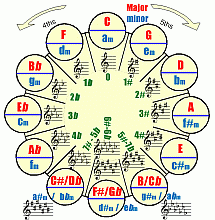 The Circle of Fifths has been developed as a way for the music student to remember how key signatures are related.
It is a great visual aid that show the math we have talked about previously.
This section provides you with steps on how to create your own tool for this basic theory.
Using the principals learned in key signature math you can create your own circle to show the fifths. The word “key” or “keys” is often used for key signature to keep it short.
You may say in the key of D, indicating that it is the key signature for D.
Build a Circle of Fifths
Using the previous principals learned about keys you can develop your circle diagram of fifths.
Starting with a blank circle you can apply the following list to create your own circle.
Alternatively our workbook the key to key signatures is a power packed way to step through this learning exercise in a way that you can systematically learn how keys are changed and built.
Print or draw up this blank template.
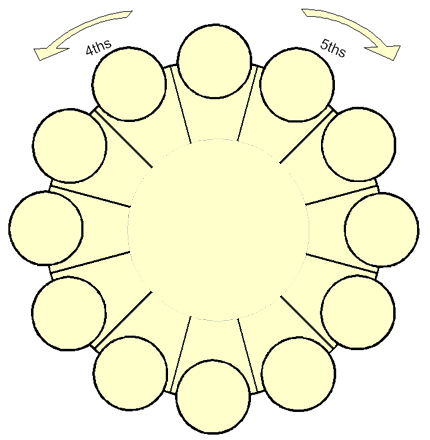
Create the Sharp Keys
Use the following steps to build sharps (look at the graphic at the top of the page if you need help)
-
Put a line horizontally through each circle
-
Put a label at the top by writing: Major – horizontal line – Minor. This means that in the top of your circles you will have major key names. In the bottom you will have minor key names.
-
Begin in the top half of the top circle with a ‘C’. This is the neutral key no sharps or flats.
-
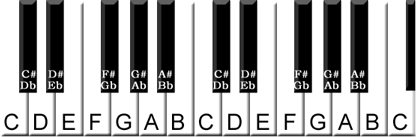
Using the keyboard below count a fifth up and write in the next key name. The first one will be G
-
Continue to count up another fifth until you have 7 key names. (the last two will be F# and C#). Squeeze the last three names to one side they will also get flat names.
Create the Flats Keys
To build the flat keys:
-
Count a fourth up from C which is F that is the first key going counter clockwise Count another 4 up and continue to add flat keys the next is Bb.
-
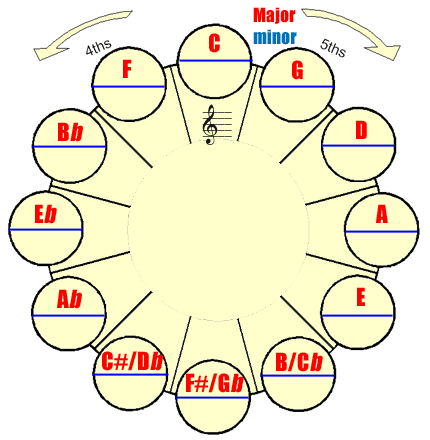
Continue by fourths and fill in until you have 7 flat keys. (three flat keys will overlap with three sharp keys).
Your template should look close to this (without the treble clef).
Number of Sharps and Flats
The next simple step is to add sharps.
-
Write the number of sharps in at the inner circle line each key gets one new sharp.
-
G = 1 sharp, D= 2 sharps and so on until C#=7 sharps.
- The sharp added at each key is a Major 7interval up from the key name. For G it is F# (or a half step down from the octave)
-
Write the Sharp name that is added on the outside of the circle. At C# it will be B#.
The next simple step is to add flats
-
Write the number of sharps in at the inner circle line each key gets one new flat.
- F = 1 flat, Bb= 2 flats and so on until Cb=7 flats.
-
The flat added at each key is a Perfect 4th interval up from the key name. For F it is Bb. For Bb it is Eb. Etc.
-
Write the flat name that is added on the outside of the circle. At Cb it will be Fb.
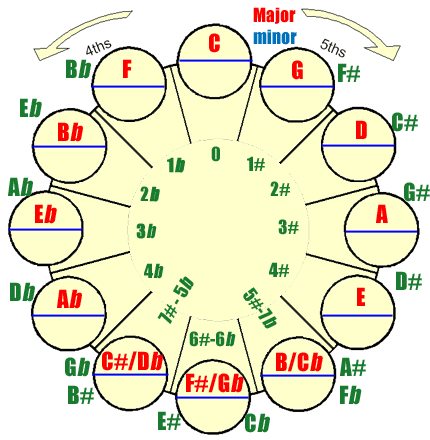
Your circle of fifths should look similar to this:
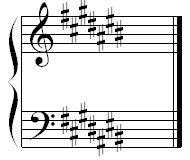
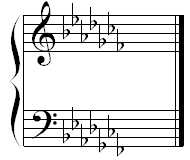
The sharp and flat sequences are fully shown below on the master staff.
Each sharp or flat is added in sequence on the note line associated with its name. You can sketch in a staff if you wish to help you see it on your circle of fifths.
Flash cards would be a good way to review the key names and number of sharps. This is covered in detail in our workbook.
All Sharps & Flats for the Key Signatures
The last thing we need to do is address the minor keys. Again this is covered in great detail in our workbook, but you can work it out here using these rules.
-
The minor keys are related to the major keys at a minor 3rd down from the major key considered.
- Write in A minor (am) under C.
-
Write the minor key in under the major key name for each key on the circle.
-
Check your key name by using the rule of fifths and fourths.
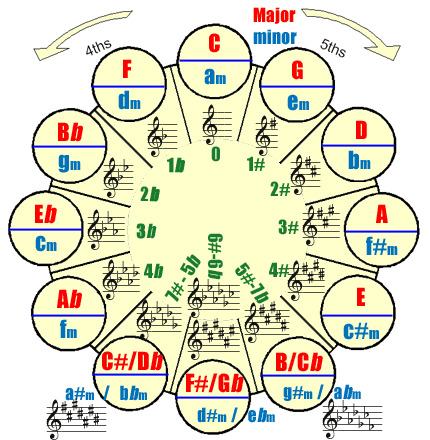
Your final circle of fifths should look like this.
That was a bunch of information provided in a short space to develop this tool. It is more than you will get with the majority of learning materials. Or it is covered in many books over a long time. Or it is just thrown at you as one big circle to figure out on your own.
Here is the rub when it comes to learning the keys. If you know them, this was an easy exercise, if not you learned a lot, but you probably don’t have them down cold.
The Workshop
 Our Getting It Down Cold Workshop on the Keys and Scales Workshop takes great pains to simplify this process
and expand on other ways to think about and reinforce the ability to
learn key signatures and this music theory element.
We cover acronyms steps to easily remember the development of the keys
and use methods to help you readily remember the key names and sharp or
flat count.
This one workbook will give you a huge jump on how others learn the key
signatures.
Having this knowledge down cold just makes it that much easier to work
with other elements of music theory. Learn More Here Learn Keys and Scales