The Tension Scale!
 The diminished scale presents a unique set of circumstances to learn a special type of scale.
Although many students learn about diminished chords the scale is not typically one of the areas that many music students take time to study.
What this really means is that you can invert the scale form and accomplish all twelve note pitch starting points. As we work through the math formula you see how this is accomplished.
The neat thing about this is that you apply the pattern three times and you have learned all the scales. They just start at different points.
Diminished types of scales can be confusing because of the application of diminishing already minor or diminished notes. Thus use of enharmonic spellings is quite common.
This simply means we use note names that are simpler to recognize and say. An example might be saying the note of ‘A’ rather than saying ‘B double flat’.
The Diminished Scales Characteristics Notation: + = augmented or raised a half step; d = dim = diminished;
bb = double flat, x = double sharp (##)
The diminished pattern uses a lot of the minor intervals. Some overall characteristics:
- There are 9 notes that make up a diminished scale instead of eight.
- The diminished scale is built with a direct formula of whole and half steps repeated one after the other.
- The diminished pattern diminishes the 3rd, 5th, 6th, m7 and 8. However, this gets to be to confusing with a bb7 and b8, so enharmonic intervals are used to make it easier.
- Enharmonic spellings are common for both scales and chords that are diminished. The 5th is often labeled both as a diminished 5 and a augmented 5. The bb7 is spelled as a 6th interval. And the d8 is a seventh.
- From the intervals we can create a whole and half step pattern to define the diminished scale.
Other things to be aware of as we work through the scale.
- The primary notes are the minor 3rds (m3rd).
- The secondary notes are in between the m3rds.
- Two full diminished chords with different notes can be created from the scale. This is developed more in the More Scales Workbook.
The unison interval is called the tonic indicating the starting note of a scale. Tonic will be used to describe the first note.
This is what the diminished scale looks like when starting on C and working into the second octave to A. We’ll explain why we use this many notes shortly.

Constructing Scales of the Diminished Type
These scales are developed mathematically using whole and half steps. We assign numeric value (an interval) to each note, the scales will use the numbers 1 2 3 4 5 6 7 8. The full diminished scale will use 9 notes.
The diminished scale pattern is a whole – half step repeating pattern. Initially one can look at it as diminishing the 3rd, 5th, 6th, a m7th, and 8th.
This is difficult to remember. Using enharmonic spellings the diminished scale will have a dim 5th and an aug 5th and is much easier to work with.
1 – 2 – m3 – 4 – d5 – +5 – 6 – 7 – 8
The Notes
C – D – Eb – F – Gb – G# – A – B – C
The Steps
S + W + H + W + H + W + H + W + H
Here is that pattern shown on the keyboard.
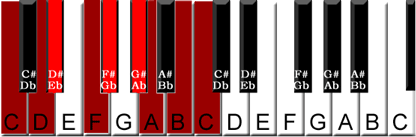
You can create the other diminished two scales using these formulas. Start on C# and D to accomplish that. The Keys and Scales Workshop fully develops these additional scales and relationships.
Diminished Scale Relationships
Previously we talked about how several diminished scales use the same notes. So four scales have these same notes and are simple inversions of each other.
How do you determine which notes define the new scale? The most direct way is by the whole – half pattern. At each point where the next step is a whole step is the new key or related scale.
Look at the C dim chord that is based on m3rds. This is the place where the whole step will take place and are C – Eb – Gb – A . These are the inversion points for the three other scales that can be built from the same notes.
Here is the math to show scales of Eb dim as part of the C dim.
C Diminished:
C – D – Eb – F – Gb – G# – A – B – C
Eb – F – Gb – G# – A – B – C – D – Eb
EB Diminished + W + H
From here the other variations are used for harmonic and melodic minors. This is the practical knowledge you need to know about minors.
Examining the Diminished Four Scales that are Related
Returning to the treble clef that had our scale notes from middle C to and octave higher A. We can show all four related scales using the same notes.
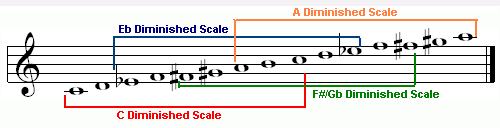
Simply starting up on the next minor 3rd the next scale can be created by inverting the notes. That’s diminished scales in a nut shell.