
Music Scales Frighten More Music Students
 Than Any Other Music Element, but with a good Key-Scale Workshop that fear will disappear!!
How to Master Over 30 Music Scales Easily and Fast with the Key Scale Workshop !!!
Knowing And Using Scales Allows You To Play and Create Music;
It Is The Basis For Key Signatures and Chord Harmonic Systems
Learn the Key Signatures and Scales – Master the Music.
With this unique approach used in the Key-Scale workshop you will learn the major and minor keys and scales and accelerate your music knowledge at 4 to 5 times what is accomplished in traditional teaching.
Learn in weeks, what takes most students years to accomplish
Hello Music Students and Teachers,
My name is Brad Chidester and I’m the owner of Music Learning Workshop.com.
I’ve studied music both the hard way and the easy way.
After finding out that there is a better, faster, and easier way to learn music I created the Key-Scale Workshop as a way to help others learn music quicker and with less effort.
The Issue:
The way music keys and scales are taught is so difficult that nearly all students struggle with the concepts.
Key Signatures and Scales get taught a little at a time and the average student only learns a handful of the thirty that are used.
The old method is too slow
and takes too long. You can find a lot of information about music theory concepts that are the basis for music learning. However…
… there is one problem with the concepts and that is you have to implement concentrated effort to actually learn the theory and to achieve mastery of music. These sources just don’t get the job done.
I even know that most teachers take way to long to get the theory taught to their students.
I know others that make sure you are getting it done at a much faster rate. And quite frankly you need to find one of those teachers.
Even when you’ve picked up the books that insult your intelligence,
(you’re not dumb or an idiot, you are simply not informed) you just didn’t get it all. Please, you wouldn’t be looking for a resource like this if you were dumb. Your smart because you’re looking for that great resource that’s going to get you where you want to go.
“Key” or “keys” is used for as a short cut to say key signature, remember to look for it in context.
Click Here to get started now!
A Scale Story.
During my continuing journey into music and especially into the jazz world, I discovered a few important things.
- I had really understood the basic major scales and one of the three other minor scales, the harmonic minor very well.
- The second was that I was really weak in with the natural and melodic minors and even more so in alternate scales such as pentatonic and polytonal scales.
- A third was that it didn’t take me too long to get up to speed on the other two minor scale systems because I understood how the basic structure and mathematics work for these scales.
The knowledge I had gained had come through the fact that my teacher had really made it easy to work with the major and harmonic minors while we studied mostly classical music. Applying that know-how made it easy to come up to speed on what I needed to study at the moment.
That ability I saw missing in other students and that is what prompted the development of a theory course dedicated to learning the scales in a direct, easy, and fast way.
What about Key Signatures
For me the key signatures were a pattern that was easy to see. It was fairly straight forward process where you could add one more sharp and you would get a new key signature.
However, I never really got the relationships or the order of things.
Why was C no sharps or flats and then G was one sharp.
It wasn’t until I started looking at moving in chords and the types of movement and the introduction to the circle of fifths that I began to put it all together.
I sure wish that I’d had this stuff earlier. That’s just the engineer in me. I like patterns and order in things.
So after a lot of consideration I decided that a course focused only on Key Signatures would benefit every music student.
Chopin was taught by theorists and in doing so composed music in a majority of the major and minor key signatures. If you take a look at any of the collection books for his music you will find that there are only a few songs written in the same key.
Today’s method of teaching key signatures is to have you learn a few of the basic ones like C and G and F and Bb, then maybe get you up to 3 or 4 sharps or flats and let it go at that.
Actually the way it’s done is by the addition of scales to your practice routine. Eventually you learn them all. Well, at least you learn the major keys and by extension you’re suppose to now know the minor key signatures as well.
You might even get introduced to the circle of fifths which does finally bring them all together.
The Importance of Keys and Scales
Learning scales and key signatures is one of the most important things you can do in learning music. It’s what allows you to take a structure and play it at different groups of notes.
Currently many teaching techniques take the approach of trying to teach music in a note by note approach. The note by note method doesn’t provide an adequate framework for which to work or create music.
Note by note allows you to only copy what someone else has created.
In order to expand or create a new arrangement of a song you need to know scale, key, and chord theories. Since chords are based on the scale it is the scale that you must learn first.
Let’s explore the music theory element of key signatures. Music Key Signatures (or keys – for short) are the playground for which chords and scales are used.
They provide the structure for moving around with chords and scales.
They give definition to the movement of music.
The key signature defines and places the sharp and flat notes that will be associated within a framework. You can then build scales and chords using the fundamental mathematics of music.
That’s why I have developed workbooks that accelerate your knowledge of these fundamental elements of music and allow you to learn music fast and get the concepts down cold.
How the Key-Scale Workshop Works
Major Key Signatures
There are fifteen (15) name labels for basic major key signatures. They can be grouped into the following:
- one key has no sharps or flats
- seven keys have sharps – but only six are commonly taught.
- seven keys that have flats and only six are taught
- 3 sharp keys and 3 flat keys have different names but have the same notes called by a different name.
What, same notes different names?
Yes, all keys have two names, and in cases we can make the case for 3 names, ever hear of a double sharp or flat?
Example, F# and Gb are the same note but have a different name. This is true for the key signatures as well.
Now 15 key signatures seems like it might be a big task to accomplish. And it will take some doing, but it won’t be as hard as you might think.
Minor Key
Signatures But wait there’s more! There is also a minor key for every major key, 15 more keys, thus doubling the number of key signatures to 30.
And what if I told you there were 3 types of minor keys.
Oh no, not 60 minor keys to learn? No not really. The minor keys are all variation of the same key. It will be the scale application that makes the difference.
It seems that this is nearly completely out of control having to deal with so many keys. The Key-Scale workshop takes this into account and makes it easy.
How to Manage Keys
At first it seems that way, but here is the thing, it can easily be broken down into manageable categories. You have patterns and groupings to help us get through all of it.
Major and Minor keys have relationships that make them easier to manage. Using simple music math You will be able to find patterns and simple systems to learn them.
So all You really need to know is how to form a major or minor key and then consider on what note it starts. The patterns remain the same, but the note names and thus the key names change.
These are the methods to learn all the keys and you will at the end of this Key-Scale Workshop section recognize and know them.
But first, you start simple and work your way through the maze in an easy and orderly way.
Scales
First you start with scale characteristics.
Different types of scales give you different structures. You can build scales and chords using the fundamental mathematics of music to provide that framework.
Learning what types of scales are available gives you a sense of the value of defining scales. We’ve talked about major and minor scales, but there are a host of others that can be explored as well such as blues, diminished, whole tone, and others.
Then you jump in and learn the first basic scale, the major scale. You learn the math of it and then you create your own set of scale sheets to help you get them down cold.
Then we turn it around and learn a second method called the Tetra Block or Tetra Chord method. Although I’m not a great fan of the tetra method it does appeal to many students.
As one of my mentors said the more ways you can look at something the more you will understand and be able to use it. That’s what we do.
Having a second alternate way of looking at scales reinforces that fundamental pattern recognition.
Then you move into the minor scales and on to the various other scales. Completing this effort sets a foundation for jumping into intermediate and advanced music study and at a pace that will shock you
How Much Time Does It Take?
Working through the scales sets require anywhere from several minutes on up to an hour each. The best part is you can stop at any point and pick it up again when you have a few more minutes.
Just a few minutes a day? That’s all you need to work through the sets.
That’s the way I do it.
What The Great Composers Studied
Did you know that the great composers where taught by theorists and were not taught note by note. They were composers because they truly understood the need for theory.
Today teaching is done almost note by note and therefore people don’t read music they spell it note by note. You can learn to play but you don’t understand what you’re playing.
It is those that learn theory that become great composers and arrangers and masters of performance.
My mentors have said that they have students who have been taught for several years and only really knew six to ten of the 30 scales.
Studying music theory is really the key to accelerating your music learning experience.
Announcing the Getting It Down Cold
Key-Scale Workshop
Your Journey To Learn And Master Music Keys Starts Here
The Key Signature section is going to take you through the steps to learn all 30 key signatures. It’s a fun way to learn, because you have to do the work to get there you retain the knowledge.
In those other books they tell you what it is and expect you to just get it.
Not here, we want to make sure you get it. Not only that we want to make sure you get it down cold.
Here’s the meat of the Key Signature section, you can see exactly what it’s going to do for you.
Introduction and concepts
Music Theory Key Signature
Characteristics
Key Signature Math
Adding Sharp Keys with Math – Adding Flats Keys with Math
Circle of Fifths
Using the Circle of Fifths – Build the Circle of Fifths – Adding Sharp
Key Signatures – Adding Flat Keys
Here’s what you will create, step by step to gain full and complete understanding.
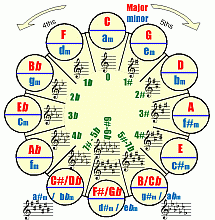
Key Signature – Sharp Notes
Learn the Sequence of Key Signatures Sharp Notes
Key Signature – Flat Notes
Learn the Sequence of Key Signatures Flats
Circle of Fifths – Minor Keys
Three Types of Minors – Build the Circle of Fifths for Minors
Working Your Key Signature Knowledge
Building Your Flash Cards – How to Use the Flash Cards – Own the Key Signatures
Next you move into Scales with the Key-Scale Workshop
The Scales work set is designed to accelerate your ability to learn music theory and be able to play music faster.
Unlike books you get off the shelf, which tell you what it is, this Key-Scale Workshop shows you how to actually learn it.
We actually lead you through a process of learning music theory step by step. With simple easy to follow concepts and then working the concept through the use of physical, auditory, and visual development.
We don’t just tell you what it is, we make you work it to learn it. Just like any good teacher would do.
Take a look at what’s included for the scale section.
Major and Minor Scales Workbook
Introduction to the Learning Methods
Using three sensors – Focused effort: – Practice technique
The Work Set Layout
Learn the basic characteristics (the new concept or idea) – Approach it from several angles – Work It – Own it –
Music
Scale Characteristics: Types of Scales – Other scales – Scale Traits of the Different Types
Major Scale Development
Major Scale Math – Practice Creating Major Scales Using the Math
Learning Major Scale Math
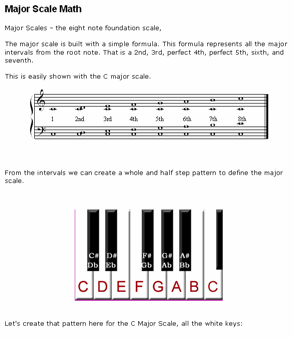
Graphics and instruction easy to follow along.
Tetra-Block Method – Developing Major Scales
Developing Sharp Scales with the Tetra Pattern – Developing Flats Keys with the Tetra Pattern
Graphic Procedure for learning
Key Signatures Using Scales
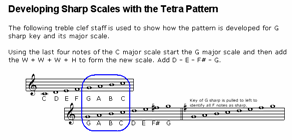
Learn how to build scales with the Tetra method
Major Scale Practice Minor Scale Development
Minor Scale Types Reviewed – Minor Scale Math – Related minors a 6th interval up or a 3rd down – Developing the Minor Scales – Build Scale Page Instructions – Major and Minor Scale Relationships –
Working It and Owning It- Practicing Scales
Practice Method – Scale Practice Chart
Then you move into More Scales
Diminished Scales
Diminished Scale Characteristics – Diminished Scale Math – First Set of Four Diminished Scales – Second Set of Four Diminished Scales – Third Set of Four Diminished Scales
Polytonal Scale
Practice Diminished and Polytonal Scales – Table of Polytonal Scales – Diminished and Polytonal Scale Practice Chart
The Whole Tone Scale
The Whole Tone Math – Whole Tone Patterns – Whole Tone Practice
The Pentatonic Scale
The Major Pentatonic Scale – The Minor Pentatonic Scale – The 12 Tone Pentatonic Scales – Using Pentatonic Scales
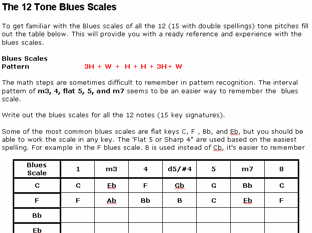
The Blues Scale
The 12 Tone Blues Scales – Blues Scale Practice – Blues Changes
The Gospel Scale
The 12 Tone Gospel Scales – Gospel Scale Practice –
Working It – Practicing Scales
Scale Practice Chart 1 – Scale
Practice Chart 2
Owning It – Practice Method
This Key-Scale Workshop covers more practical music theory in One book than a several method books which cost you far more.
Click Here to get started Now!
The Big Picture Way
Using the Scales so that you learn them quickly and put them together in a big picture gives you a jump on learning all the other aspects of music.
It used to be that you would learn a only a few of the most popular keys then you would run into a new one that you just didn’t know.
You never got the full picture in a way that really made then connected. The Key-Scale Workshop does just that.
You have patterns and groupings to help get through learning scales and then by extension chords. They can easily be broken down into manageable steps and categories.
You will own music structure. In this Key-Scale Workshop you will discover the relationships in mathematical terms of how the keys and scales are developed, learn how the different keys and scales are related and be able to move from one type of scale to another.
The most important thing is that you will have the foundation in hand that allows you to advance into the various advanced theory and applications of music.
What Other Students Say
Breakthroughs at Every Level
These quotes are paraphrases of what my fellow students and their teachers have said about using these accelerated learning methods.
…Learning scales in a holistic way puts the whole music theory system into perspective. The relationships between the major and minors was essential in my understanding of the two types of scales.
…When teaching these concepts to my students you can see the light go on when they start to see the easy math and pattern relationships. Using the scale and the related harmonic system to analyze and teach songs is seeing incredible leaps in speed of learning. We’re simply getting breakthroughs at every level.
What do I need to know to use this Key-Scale Workshop?
You need to know about notes. If you don’t know where the notes are on a piano then you need to also start with the notes workshop to build the foundation necessary to get these concepts.
You should know about note names and what are sharp (#) natural and flat (b) symbols. You should be familiar with how these symbols are used.
You should be versed with the master staff and intervals.
Without the knowledge for this the scales will be very difficult to learn.
I’m going to suggest that you take a look at the NOTES WORKSHOP.
You won’t regret knowing all the notes of the master staff.
You have to have a basic understanding of intervals we talk a lot and use intervals when defining scales. And when we talk about minor keys the minor intervals are a must know.
100% Risk-Free Guarantee
The Two Volume Scales Workbook comes with a no-questions-asked, no-hassle, 60 day money back guarantee.
If for any reason whatsoever you decide you aren’t completely satisfied with the Key-Scale Workshop just email me anytime within the next 60 days and I’ll buy it back from you.
 Risk Free
I’ve got to offer you an 8 week, money back guarantee. I’m absolutely fine with that. I stand behind my workshop completely and know you’ll be completely thrilled with the lessons and more importantly, the result.
Start using the Key-Scale Workshop and begin seeing immediate results from this system of learning or get your money back, it’s as simple as that.
The longer you wait to get started the longer it will be before you see results.
Don’t put it off and then six months from now think about how much time and money you will have lost.
If you want to make progress you have to begin now.
Get the Key-Scale Workshop Now!
Ok Brad, I’m Ready
to Master Keys and Scales .
Get it Here!
The Key-Scale
workshop for the budding musician is essential.
It’s available right now for download.
Don’t be fooled by the e-book download. This is 100% workshop material designed to be used on your computer.
You only print what you need for a work-set and you learn more about keys and scales ultra fast.
As a special bonus
I’m throwing in the Learn a Song Report for free!
Go to the Store to
See Bundles with the Keys and Scales Workshop:
 Workshop Bundles at the MTW Store
Instant Download via zip file with PDF format book
Disclaimer *
Every effort has been made to accurately represent this product and its potential. Please remember that each individual’s success depends on his or her background, dedication, desire and motivation. As with any endeavor, there is no certain guarantee that you will learn or achieve the success as fast as predicted.
… yes get immediate access even at 2:00 A.M.
Here’s to you mastering music,
PS: With the Scales Workbook you have laid the foundation for working with all the other elements of music. Armed with this knowledge you will be taking on more advanced concepts in no time at all.
To Your Success!