Frequently Asked Questions about the Music Theory Course
Also see General FAQ’s
Faqs:
Which Course or Workshop is best for me?
Will I learn how to play my instrument?
Does this work for Guitar Players?
How does learning music theory help me become a better musician?
Is the Music Theory Course available in hard copy?
Do you have any personal instruction?
Can I use this on the iPad? and zip file download
Which Course or Workshop is best for me?
Choosing a Single Workshop or the full course only requires taking a self evaluation. Where are you at and What do you need to learn? These descriptions should help you zero in. What we usually find is that even if you’ve had some lessons, starting from scratch and going through all the material is still wildly beneficial.
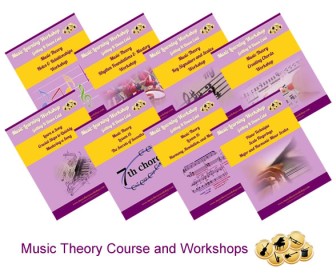
Full Course: If you know very little about reading and understanding music, you have two options to take the full course and learn the beginner and intermediate level in one year. The full course let’s you learn at your own pace, but comes with a weekly e-mail to keep you on track.
Having the full course let’s you look into the music elements as you wish. However, this can be a distraction and get you off course, be careful in that approach.
Note: The music courses cover all 4 Workshops, but in a programed order to allow you to get exposure to all areas of music theory building on each element.
Workshops:
Notes Workshop – If you know nothing about reading music this is the place to start. This Workshop covers the time and pitch elements of notes. You get a through understanding of the different display of whole notes to sixteenth notes to understand how they fit in rhythm. You also cover the pitch relationship and the Master Staff, learning it and mastering it in just a couple of weeks. The last section covers intervals or the relationship of notes.
Rhythm Workshop – This workshop is designed to help you learn and then master rhythm. It’s for all levels of musicians and focuses on 36 different rhythm patterns to help you move from basic learning, to endurance, to grooving. These practice sets explore the basic need to know rhythms so you can learn to get into the rhythm continuum. This is a must do if you are ever going to entertain or play with a band.
The following workshops require a basic understanding of notes as described above.
Scales and Keys Workshop – This workshop advances you into learning the structure of music. This workshop when combined with the Chords workshop will have you learn all the key signatures and the major and minor scales associated with each. In addition you cover the altered scales to understand how Blues, Gospel, and the Jazz world uses scales. Learning the principles of scales is where improvisation and arranging begins. If you are struggling or don’t know anything about scales this is an excellent workshop to quickly bring you up to speed.
Chords Workshop – The chords workshop is really the heart of learning the song structure and flow. Understanding how chords are constructed within a Key Signature and Scale is essential to your ability to learn and understand songs. The workshop not only covers the basic 4 chord construction, but has you work through the “Diatonic Major/Minor Harmonic Systems” which is the knowledge really needed to master learning and creating songs. You should consider this workshop if you don’t understand chord structure or their relationships.
Individual Lessons:For those looking to target a specific music element. We’ve broken the workshops down further to allow for individual lessons. Click on the link to visit the lesson page to pick out what you need.
Will I learn how to play my instrument?
The music theory course is designed to teach you music theory. In that process you will learn to read notes and music. The course is not designed to teach you to specifically play any instrument. You need to know where notes are located on your instrument and some technique of playing. If you have some basic playing skills this course will help you play better or learn songs faster.
One thing new students don’t realize is that playing and instruments is two fold. It’s first learning the technique or way to play that instrument and second in reading and understanding music. Music Learning Workshop is about the later.
How does learning music theory help me become a better musician?
Learning music principles and theory lays a foundation of being able to explore more music in depth and understand the complexities of composition, arranging, and more quickly learning a song. Reading the “Learn A Song report” shows how to use music theory to aid in learning a new song without having to do it note by note. Also I’ve posted a series on arranging a song at an advanced level that helps you explore the power of music theory, check it out here: The power of music theory in arranging music.
Is the Music Theory Course available in hard copy?
Currently we are not publishing the course in hardcopy. Because of the formatting and color illustrations used to enhance the presentation and ease of learning the materials, the complete course is several hundred pages long. Print costs more than doubled our cost to bring the course to market. We have not ruled out a future hardcopy option at a premium cost.
Do you have any personal or video instruction?
No, there is no personal instruction. This is not a video course although there are a few videos that go with some of the lessons. This course was designed to meet the majority of needs and potential students of music theory through electronic delivery. It is a self study workshop format which systematically leads you through a step by step process to learn music theory.
Can I use this on the iPad? zip file download.
Yes, the files are pdf and can be read on the iPad.
The majority of the course materials download as a zip file. In order to use that on an Ipad you need the iZip application. This application also works with the dropbox app and is an easy way to download, unzip and have the files on your computer later.
http://itunes.apple.com/us/app/izip-zip-unzip-unrar-tool/id413971331?mt=8
Some parts are delivered in pdf format, so using the iPad you have to download and save to one of your reading programs, like iBooks.